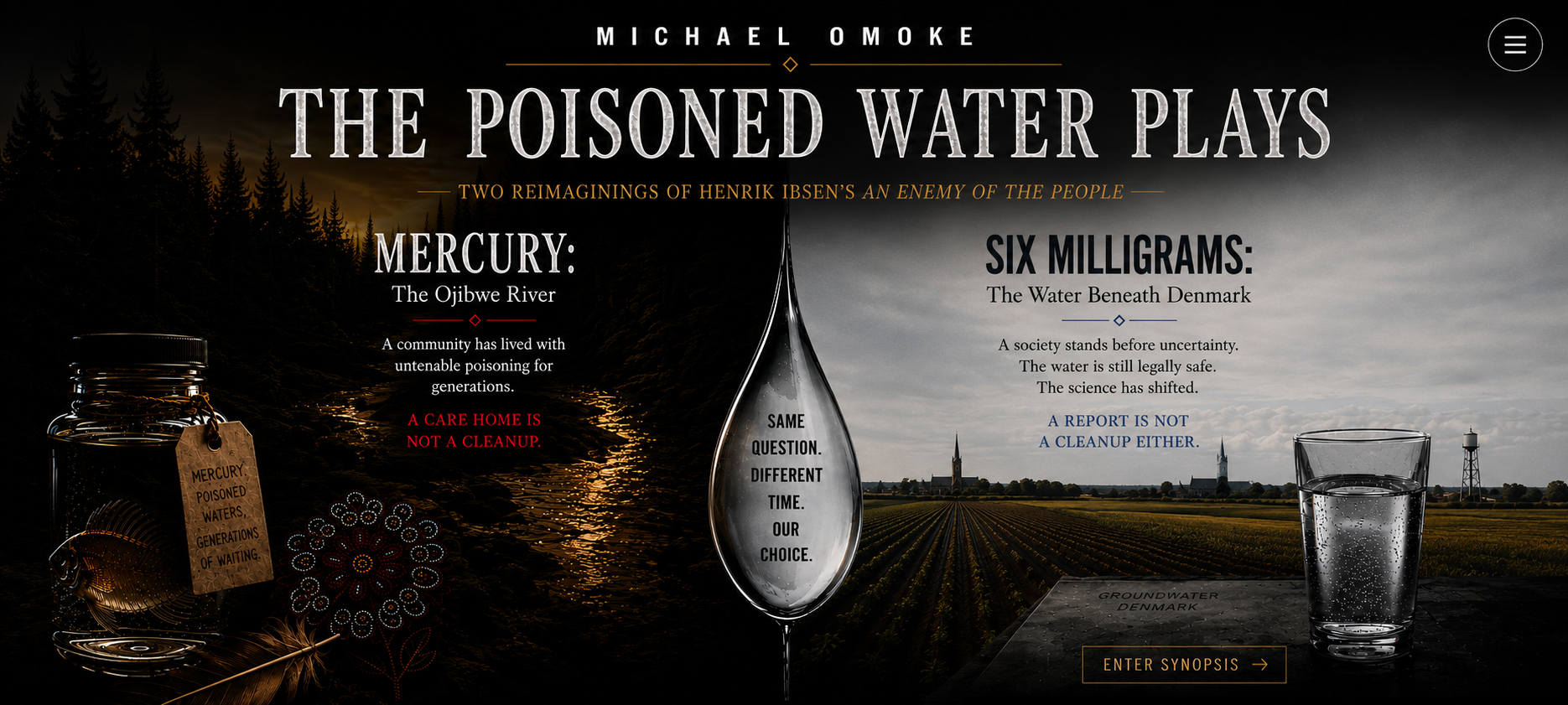
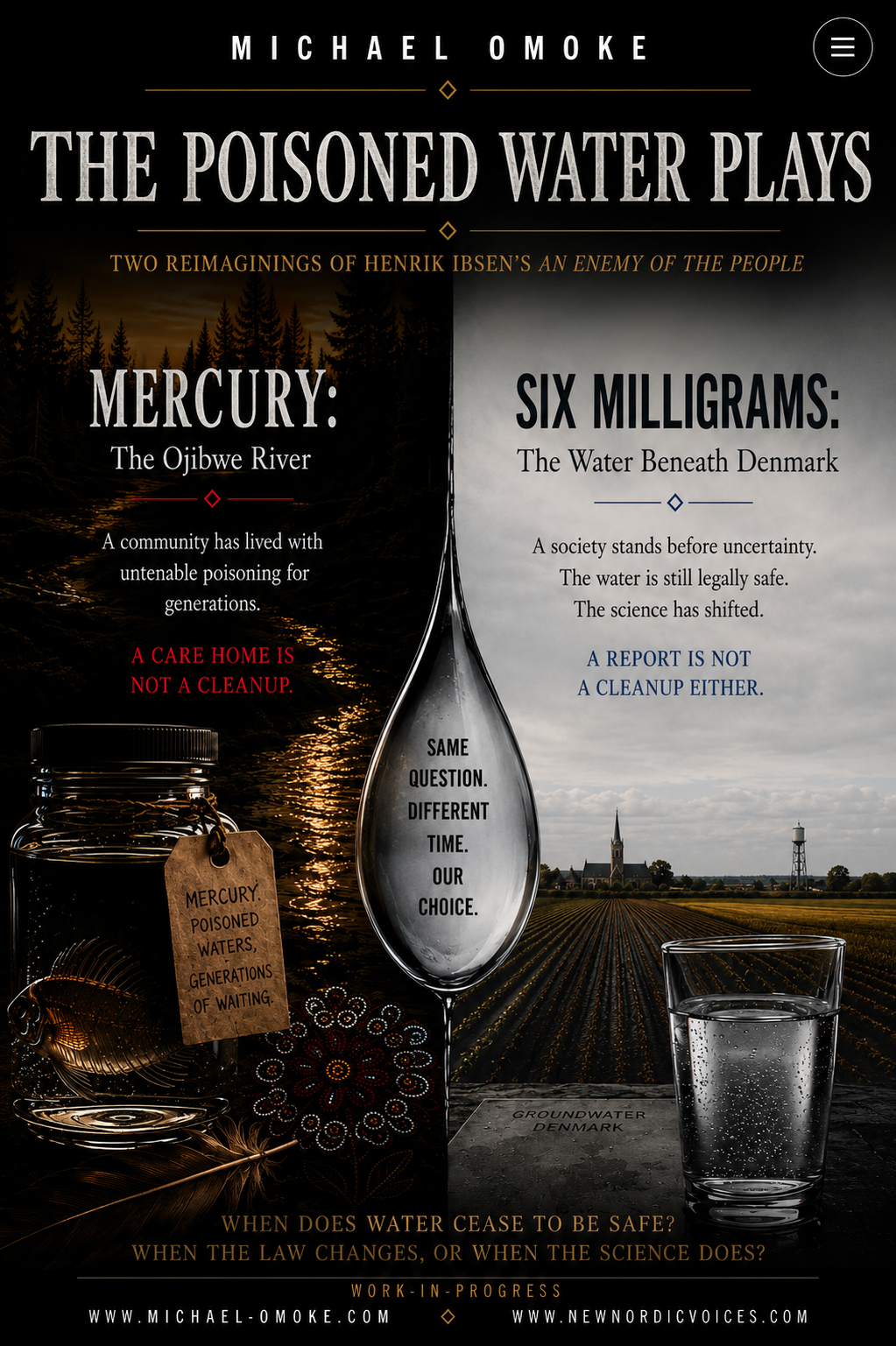
The Poisoned Water Plays

CANADA · THE RIVER

Mercury

The river fed families.

The river carried work.

The river carried memory.

Then it carried mercury.

Enter the river
DENMARK · THE LAND

Six Milligrams

The land feeds families.

The land carries debt.

The land carries inheritance.

Beneath it, the water receives everything.

Descend beneath the land
ACT III · HOW POLLUTION TRAVELS

One pollutant travels downstream.The other descends beneath the land.

Science can trace both journeys. It cannot decide who must bear the cost of stopping them.

ACT IV · THE HUMAN CLAIMS

Three voices enter the same room.

Each speaks a truth. None can settle the conflict alone.

THE ECOSYSTEM
I carry every decision downstream.

Water joins what ownership, borders and institutions divide.

LIVELIHOOD
Change may be necessary. Loss is still real.

A fishery can hold sovereignty. A farm can hold inheritance, debt, family and place.

EVIDENCE
I can reveal the harm. I cannot decide who must sacrifice.

Measurement enters a world already divided by power.

And while every human position finds its defence,the water continues to receive the consequences.
ACT V · THE FIRST PLAY
After the poisoning

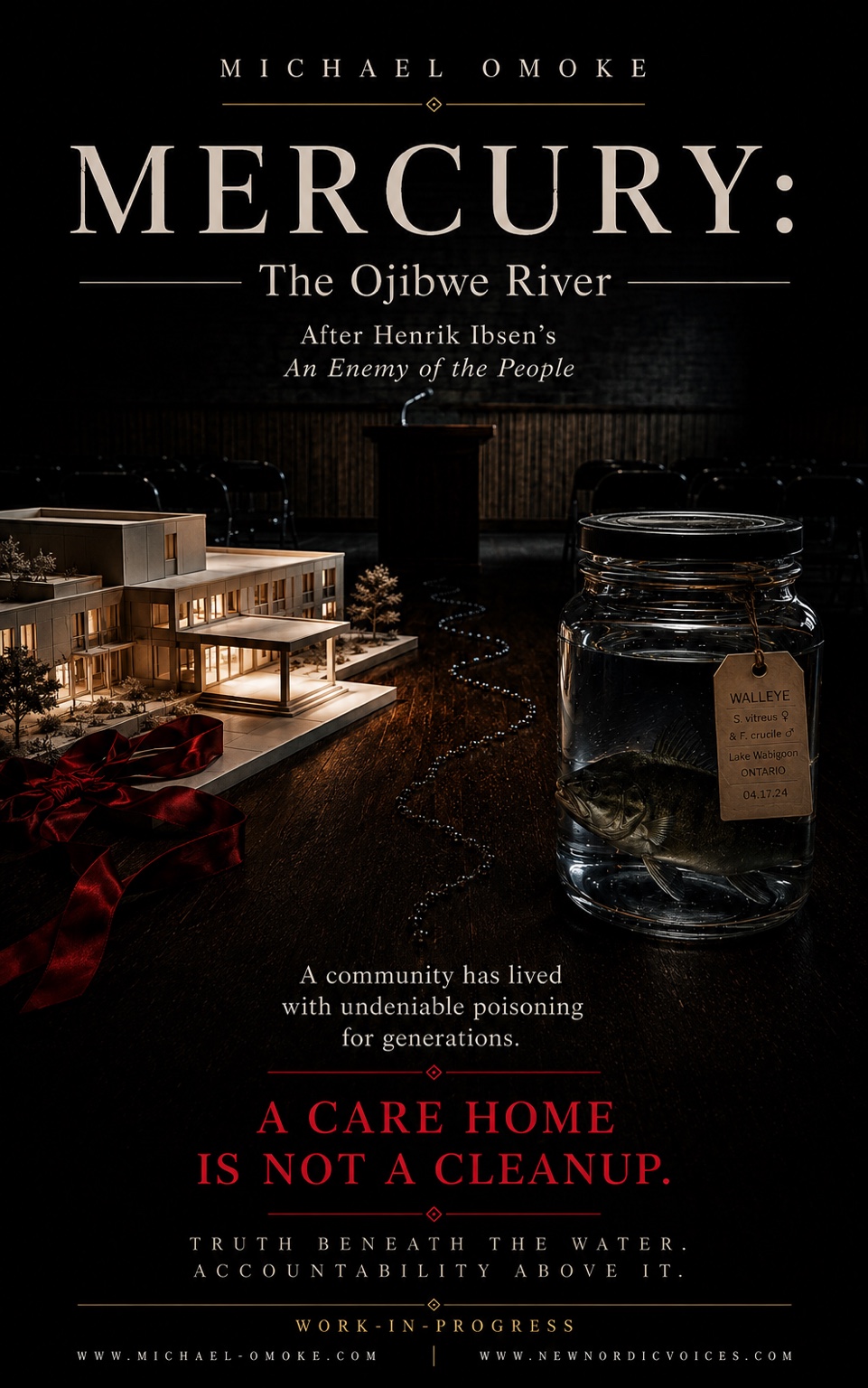
Mercury

The Ojibwe River

A livelihood was taken by the poison. The river is still waiting.

Final vertical poster for Mercury: The Ojibwe River
Selected chronology

Pollution does not remain where commerce releases it.

Follow the public record as an industrial discharge becomes an ecological, bodily and cultural inheritance.

The English–Wabigoon river system A stylised westward river route from Dryden through Wabaseemoong to Grassy Narrows, animated by a silver contamination current. DRYDEN WABASEEMOONG GRASSY NARROWS ENGLISH–WABIGOON RIVER SYSTEM
01 / 071962

Industrial mercury discharge begins.

Verified reality · July 2026

Care has begun. Ecological repair has not.

As of July 2026, the English–Wabigoon river system remains contaminated with mercury. Government-funded work remains in study, monitoring and characterisation. There is still no approved physical remediation plan, no public cleanup timetable and no active physical cleanup underway in the river or its sediment.

The community’s long-fought-for care home is a necessary achievement. It addresses the people forced to live with the poisoning. It cannot substitute for repairing the ecosystem from which the harm continues to flow.

The care of the poisoned has begun.
The care of the poisoned river has not.
Verified against publicly available government reporting and independent journalism. Research status reviewed July 2026.
THE RIVER REMEMBERS

Four objects remain after the speeches end.

Health, livelihood, food and memory were never separate.

The river system

Water carries memory downstream.

The English–Wabigoon system binds industry, community and consequence across generations.

The discharge years

Eight years entered the water.

The contamination did not remain inside the years in which it was released.

The closed fishery

A food system became evidence.

What sustained life became the clearest record of what had entered it.

The care home

Care is necessary. The river remains.

A hard-won community achievement cannot be asked to stand in for remediation.

ACT V · THE SECOND PLAY
Before the poisoning

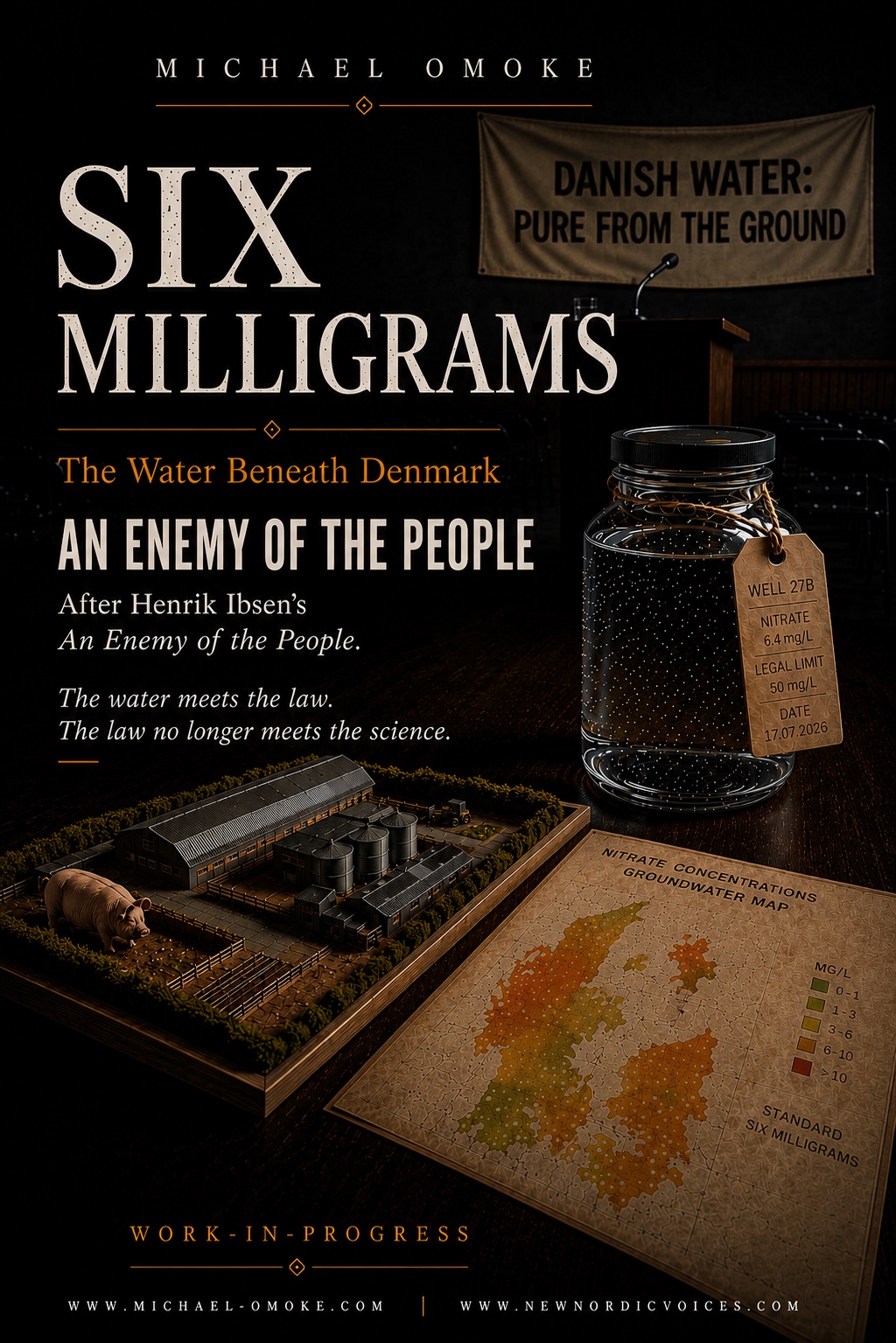
Six Milligrams

The Water Beneath Denmark

The land sustains a livelihood. The water records its accumulated cost.

Final vertical poster for Six Milligrams: The Water Beneath Denmark
The danger is beneath the ceremony

A landscape is also an economic system.

Descend from the visible life of the farm to the groundwater beneath it.

01

Surface

Fields, livestock, fertiliser, family farms and a nationally televised celebration of clean water.

02

Soil

Nitrate and pesticide residues move downward through years of accumulated agricultural pressure. The source is dispersed across an entire productive landscape.

03

Groundwater

The wells remain legally compliant. Research complicates the meaning of safety, while regulation must also confront food production, rural employment and economic survival.

04

The tap

The water reaches the glass unchanged to the eye. Inside it meet the interests of the household, the farmer, the municipality and the ecosystem.

Evidence does not make the decision

A legal limit is not a moral verdict.

3.87mg/L
reported association

Denmark’s drinking-water limit for nitrate remains 50 milligrams per litre. A nationwide Danish population study reported a statistically significant association with increased colorectal-cancer risk above 3.87 milligrams per litre, far below the legal limit.

The study does not, by itself, determine agricultural policy or establish six milligrams as an official safety threshold. It introduces evidence into a conflict already shaped by food production, farm livelihoods, public health, regulation and the cumulative condition of the groundwater.

Science can identify the pressure.
Society must decide how the burden of change is shared.
Based on the current European drinking-water standard and Danish population research. Research status reviewed July 2026.
THE ROOM ABOVE THE WATER

Four human claims. One silent witness.

Each claim is legitimate. None prevents the nitrate from descending.

THE FARM

We feed the country.

Family, debt, inheritance and a national appetite for production.

THE MUNICIPALITY

We must govern what is possible.

Law, employment, health and the political cost of choosing.

THE WATERWORKS

We deliver what the public must trust.

A clear glass, drawn from a landscape no filter can separate from its history.

THE HOUSEHOLD

We drink the result.

Distant decisions become intimate at the kitchen tap.

THE WATERreceives every answer.
Mercury · Canada

Pollution destroyed a livelihood.

The river once sustained fishing, food, work, culture and autonomy. Industrial contamination made that relationship dangerous.

Six Milligrams · Denmark

A livelihood may contribute to pollution.

The land sustains farmers and rural communities. Its productive system also places cumulative pressure on the groundwater below.

THE WATER SPEAKS LAST

When every human interest can defend itself,
who speaks for the water?

The Poisoned Water Plays

Not a contest between villains and heroes.

A theatrical inquiry into what human prosperity owes a living ecosystem, and how the burden of ecological repair is distributed when every available choice carries a cost.

A declaration of form and fact

Mercury and Six Milligrams are works of fiction, not documentary theatre.

In Mercury, the characters and the First Nation community in the play are fictional. The historical mercury contamination, and the continuing public questions surrounding care, remediation, drinking water, industrial activity and responsibility, are documented realities.

In Six Milligrams, the characters and the municipality are fictional. The legal nitrate limit, the Danish population study and the continuing public debate surrounding groundwater, agriculture, health, regulation and responsibility are documented realities.