

HEDDA
GABLER
IN FRANCE
A psychological noir thriller in four acts after Henrik Ibsen by Michael Omoke.
Pont-Saint-Esprit, autumn 1951. Ibsen’s drawing-room tragedy is moved into a contaminated intelligence chamber: a CIA safehouse overlooking a village that has begun to hallucinate, while papers are misplaced, burned, classified, and denied.
POSTER PLATE · WORK-IN-PROGRESS
The first visual threshold for the dedicated Hedda dossier.
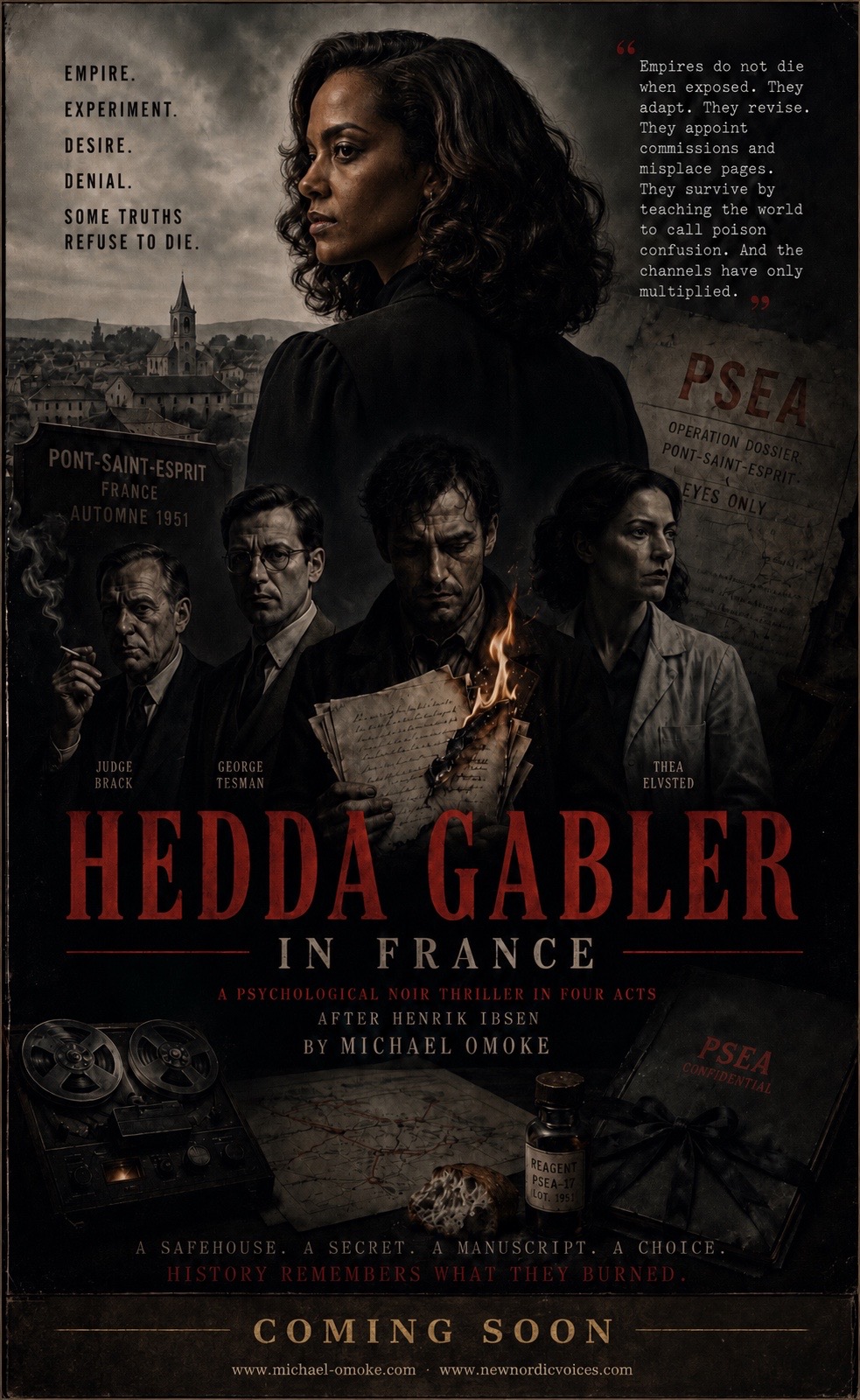
Ibsen enters the intelligence chamber.
Pont-Saint-Esprit. A contaminated village. A CIA safehouse above the valley. Misfiled papers. Hallucinations. Surveillance. A woman trapped inside state machinery.
The proposition
This is not Hedda “updated.” This is Ibsen placed under Cold War pressure — where desire, state secrecy, surveillance, and psychological collapse become part of the same machine.
The room
A safehouse. A secret. A manuscript. A choice.
In this reimagining, Hedda Gabler is no longer held only by marriage, boredom, and bourgeois expectation. She is drawn into the architecture of state secrecy: files, memoranda, laboratories, classified routes, and the language by which violence is made administrative.
The classic domestic chamber becomes a Cold War room where desire and power are inseparable from experiment and denial. The pistol still matters — but so does the file, the report, the destroyed page, and the official sentence that teaches the world to call poison confusion.
The work belongs to Michael Omoke’s wider method of placing canonical texts inside charged historical climates so that the inherited work returns altered, carrying the pressure of the worlds it has passed through.
Access
For artistic, institutional, and production dialogue.
The full script and deeper dossier are handled selectively. For rights, dramaturgical conversations, readings, or institutional discussions, contact Michael Omoke.